
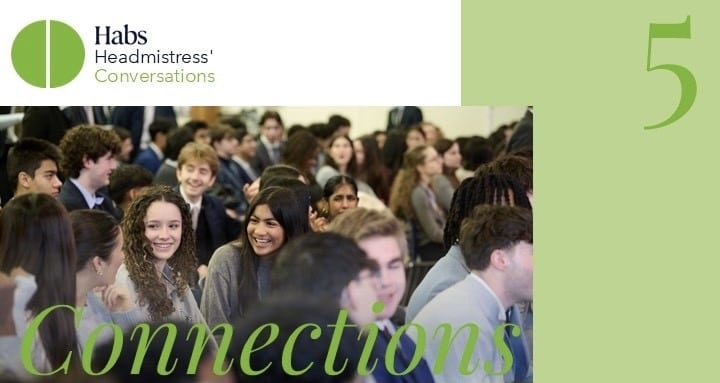
One of the lovely things about this time of year is receiving messages of thanks from parents as their daughters prepare to leave the school. Recently, I received a lovely email from a Year 13 parent thanking us for the experiences and opportunities her daughter had enjoyed during her 14 years at Habs. What struck me most was the number of references to ‘connections’ she had made, whether friendships, relationships with staff, and the wider connections developed with students from other schools through our partnerships programme, as well as on the lacrosse pitch or at MUN events. It made me reflect on how important these connections are.
As our Year 13 students approach this significant milestone, there is often a focus on outcomes and next steps, but what stands out just as powerfully is the network of relationships each student has built, and how these have shaped who they have become.
In an educational landscape shaped by outcomes and performance metrics, it is easy to overlook the role relationships play. Yet it is through connection with peers, teachers and wider communities that confidence, identity and resilience are formed.
Connection in a school community is rarely dramatic. More often, it is built in small, everyday moments that become deeply significant over time. Friendships are formed and reshaped; relationships with teachers grow through encouragement, challenge and respect, and a sense of belonging to a wider community begins to take root. As students move through the school, these relationships become increasingly formative. They provide the foundation for confidence, which develops not in isolation, but through interaction. Belonging is not a by-product of education; it is one of the conditions that makes learning possible.
A student speaks up because she feels supported, tries something new because someone has encouraged her, or perseveres because she knows she is not alone. Young people are far more likely to take intellectual and personal risks when they feel known, supported and valued. In this way, connection underpins not only wellbeing, but also achievement and personal development.
For students in Year 13, this is a moment when the value of those support networks often becomes clearer. Many will recognise how much they have relied on those around them, not just academically, but personally: the friend who made a difficult day easier, the teacher who offered guidance at the right moment, the team or society that provided a sense of purpose.
Habs Girls is one community made up of many communities: students, families and staff bringing a rich variety of cultures, identities, traditions and perspectives. Our strength lies not only in recognising this diversity, but in how it shapes the connections our students experience every day. Through shared learning, collaboration and conversation, students develop a deeper understanding of the journeys and challenges within our community. Through our commitment to EDI, we strive to create a culture where every member feels welcomed, valued and able to thrive. This involves celebrating traditions and contributions, while also listening with empathy and respect to different experiences. It is through these connections between pupils, families and staff that our community is strengthened.
Opportunities to connect across generations also shape a sense of belonging. Through initiatives such as Old Haberdashers Day and Habs in Conversation, students engage with former pupils whose lives and careers have taken many different paths. Recently, students interested in the creative industries heard from inspiring members of the Habs community including Nica Burns CBE, Laura Aikman and Georgie Black, who shared not only their professional experiences, but reflections on resilience, confidence and navigating uncertainty. These conversations remind students that the values, relationships and sense of identity formed at school continue long beyond their final day, reinforcing that they are part of a community that extends across generations.
Ultimately, what students carry with them is not only what they have achieved, but who they have become through the relationships they have formed.
As our Year 13 students prepare to leave, the connections they have formed here do not simply end; they evolve. An excerpt from the final school magazine published at Acton in 1974 captures this sense of connection: “The years in Acton will mean different things to different people…but these differences are merely superficial, for we all share a common heritage. There will inevitably be changes, but we shall remain a Haberdasher community, and our links with the past will be as strong as ever.” That sentiment still resonates very deeply today.
Dr Hazel Bagworth-Mann